
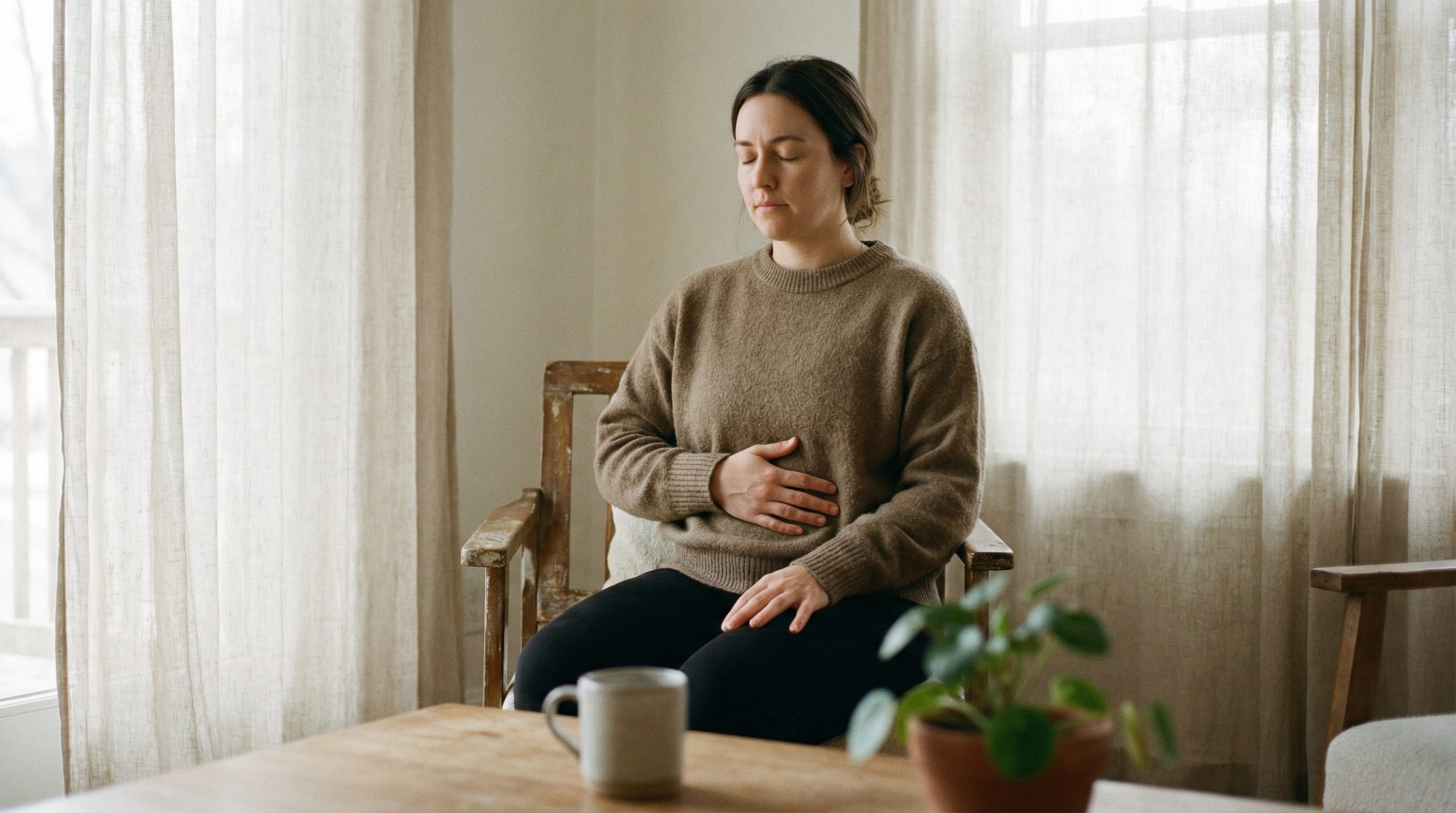
Anxiety can feel like a mind problem.
Racing thoughts. Worry loops. A sense of urgency.
But anxiety is also a body state. Breath gets shorter. Muscles tighten. The nervous system leans toward “threat mode.”
That’s why breathing techniques for anxiety can help so quickly. You’re not trying to win an argument with your thoughts. You’re giving your body new information—pace, rhythm, and a softer exhale—so the system has a reason to settle.
Start here (60 seconds)
If you feel a sudden spike—overwhelm, panic-y energy, frustration—don’t overcomplicate it.
Do 1–3 rounds of the physiological sigh:
- Inhale through the nose.
- Take a second, smaller “top-up” inhale.
- Exhale long and slow.
Then switch into 1–2 minutes of the extended exhale pattern below.
A simple rule that makes this easier
Ask one question:
“What state am I in… and what state do I need next?”
| What you feel | What you need | Try this |
|---|---|---|
| Wired, jittery, stuck in your head | Downshift | Extended exhale breathing (2 minutes) |
| Sudden spike / panic-y surge | Immediate reset | Physiological sigh (1–3 rounds) |
| Background hum of anxiety most days | Daily regulation training | Cyclic sighing (5 minutes/day) |
| Pressure + performance stress | Rhythm + focus | Box breathing (modified if needed) |
Pattern 1: Extended exhale breathing
If you want the simplest “calm switch,” start here. It’s discreet. It’s gentle. And for most people, it’s hard to overdo.
How to do it (2 minutes)
- Inhale gently through the nose for 4.
- Exhale slowly for 6 (or 7–8 if it feels easy).
- Repeat for 10–15 breaths.
Keep it comfortable. If you feel air hunger or agitation, shorten the exhale. The goal is ease—not willpower.
When this works best
- At night when you want sleep without wrestling your thoughts.
- During the day when you need to settle quietly and keep moving.
- After stress—emails, conflict, doomscrolling—when your system is “up” and you want to come back down.
Pattern 2: Cyclic sighing (5 minutes a day)
This is a structured version of something your body already knows: the sigh.
In a randomized study comparing brief daily breathing practices with mindfulness meditation, 5 minutes a day of breathwork improved mood and reduced physiological arousal—especially the exhale-focused pattern known as cyclic sighing.
How to do cyclic sighing (5 minutes)
- Inhale through the nose (normal inhale).
- Take a second, smaller “top-up” inhale to comfortably expand the lungs.
- Exhale long, slow, and relaxed.
- Repeat at a steady, comfortable pace.
Two cues that keep it grounded: relax the shoulders, and let the exhale be soft (not pushed).
If you feel lightheaded
That’s usually a sign you’re breathing too big or too fast.
Make the breaths smaller. Slow the pace. Return to comfort. Regulation beats intensity.
Pattern 3: Box breathing (calm focus under pressure)
Sometimes anxiety isn’t “panic.” It’s scattered attention. Pressure. Performance stress.
Box breathing gives your mind a simple rhythm to hold onto.
How to do it (3 minutes)
- Inhale for 4.
- Hold for 4.
- Exhale for 4.
- Hold for 4.
Repeat for 4–6 rounds.
Modify it if holds feel stressful
- Use a smaller count (3–3–3–3).
- Or remove holds and do 4 in / 4 out for 2–3 minutes.
If retention increases anxiety, don’t force it. Go back to extended exhales or cyclic sighing.
A simple 5-minute daily protocol (for the next 14 days)
Consistency beats intensity.
If you want one plan that’s easy to repeat:
- Minute 1: Extended exhale breathing (4 in / 6 out).
- Minutes 2–5: Cyclic sighing at a comfortable pace.
Do it once a day. Same time if you can. Let your body learn the pattern.
How to tell it’s working
- You downshift faster (even 10–20% calmer is a win).
- Your breath naturally slows after practice.
- You recover from triggers faster.
- Sleep comes easier on practice days.
- You respond with a little more choice—and a little less reflex.
Common mistakes that make anxiety breathing backfire
1) Going too big
When people “try hard,” they often breathe too deeply or too fast. That can increase dizziness, tingling, or agitation. Smaller is usually better.
2) Forcing the exhale
Long exhale helps. Forced exhale adds tension. Let the exhale be long because it’s soft—not because you’re pushing it out.
3) Only using breath as a rescue tool
Breath can rescue you in the moment. But it also trains your baseline over time. Daily practice is where the deeper change happens.
Safety notes
These breathing techniques for anxiety should feel steady—not aggressive.
If you feel dizzy, numb, or panicky, stop and return to normal breathing. Then try a smaller, softer version.
- If you have a respiratory condition (asthma, COPD) or you’re pregnant, start with gentle extended exhales and avoid strong breath holds unless cleared by a clinician.
- If anxiety is persistent, worsening, or includes panic attacks, consider working with a licensed professional. Breathing is supportive—but it’s not a substitute for care.
From practice to mastery (Breath Mastery)
Reading a technique is a start. The real change happens when breathing becomes a skill you can use in real life—during conflict, fatigue, uncertainty, and growth.
If you want structure and guidance, explore Breath Mastery Training Programs, review the Practitioner Program, or check upcoming live events.
Conclusion
If you want the fastest downshift, start with extended exhales.
If you want a short daily practice, do cyclic sighing for 5 minutes.
If you need calm focus under pressure, use box breathing (modified if needed).
The goal isn’t perfect technique.
The goal is a nervous system that remembers—through repetition—that it can settle.
FAQ
What is the best breathing technique for anxiety in the moment?
Start with 1–3 rounds of the physiological sigh, then do 1–2 minutes of extended exhales (4 in / 6 out). Keep it gentle. If breath holds feel stressful, skip them.
How long does it take to feel calmer?
Many people notice a shift within 1–5 minutes. If you’re highly activated, go smaller and slower. Daily practice usually reduces the time it takes to downshift.
Is cyclic sighing the same as hyperventilating?
No. Cyclic sighing is a double inhale followed by a long, relaxed exhale. If you feel lightheaded, you’re likely breathing too big or too fast—so slow down and reduce the breath size.
Can box breathing make anxiety worse?
For some people, holds can feel activating. Modify it (3–3–3–3) or remove holds and do 4 in / 4 out. If it still feels stressful, choose extended exhales instead.
Are breathing techniques enough for severe anxiety?
They can help as daily regulation tools, but they’re not a replacement for professional care. If anxiety is persistent or includes panic attacks, consider working with a licensed clinician.
