
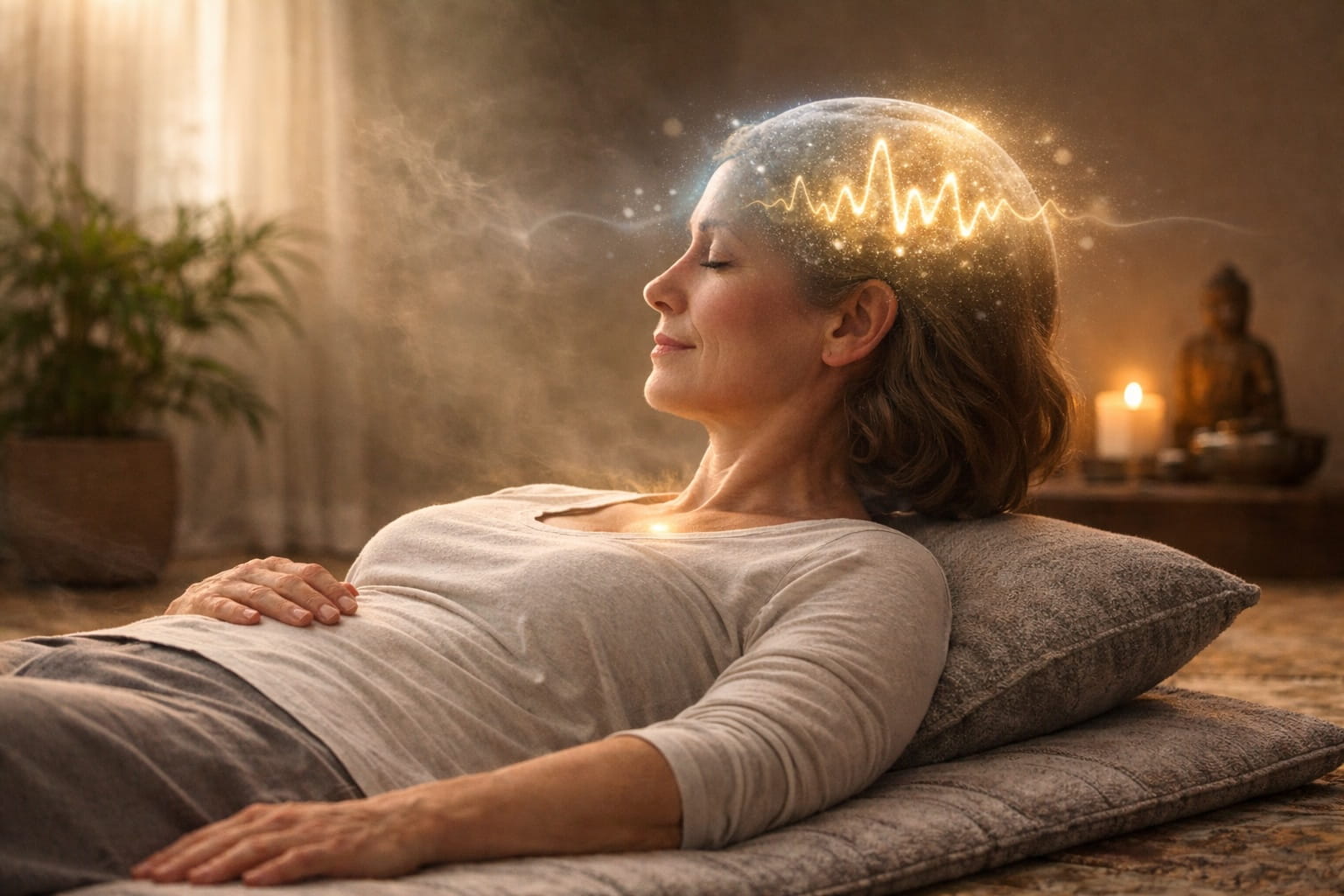
From the moment most people get up in the morning, they are busy with work and life, and they are forced to deal with constant stimulation. The only rest they ever get is sleep. And even that is not often sound or restful.
But there is a powerful middle ground between wakefulness and sleep known as Non-Sleep Deep Rest (NSDR)—which is a modern term for an ancient practice called Yoga Nidra. And that is the topic of this month’s article.
It is a practice that brings the nervous system into profound restoration without falling asleep. What modern neuroscience has discovered is that the body and brain can enter a deep regenerative state while consciousness remains gently aware.
NSDR or Yoga Nidra induces a state of parasympathetic dominance—the “rest and digest” branch of the nervous system—without the need for full sleep. Heart rate slows. Muscles release tension. Stress hormones decrease. Brain waves shift toward slower alpha and theta rhythms.
Unlike scrolling on your phone or vegging out in front of a screen, NSDR is intentional. You rest deeply, but you are not unconscious. It counters the chronic low-grade stress most people live with 24/7/365. This is important because even when people are physically still, their minds often continue racing. Over time, this wears them out no matter how much sleep they get.
NSDR is about deep relaxation. It improves emotional regulation. It enhances learning and improves memory. It accelerates recovery from illness, injury and fatigue. It supports neuroplasticity. It helps the brain consolidate learning and information more effectively. And it dramatically reduces anxiety and stress.
10 to 20 minutes of NSDR can feel more restorative than several hours of sleep, and without the grogginess that sleep can bring.
Breathing is central to this practice. Slow, rhythmic breathing—especially while effortlessly extending your exhales. This tells the brain that the environment is safe. And muscular relaxation automatically follows.
Conscious breathing along with a special kind of awareness—the kind that does not disturb nature is a major part of NSDR. The quality of awareness can be described as an open internal focus that frees us from external stimulation and allows an inner peace.
This inward attention is vital. Soft awareness remains present while sensations, thoughts, or subtle imagery arise, but instead of engaging or reacting, you simply allow yourself to be as these things naturally come and go. It is not about forcing silence. It is about allowing a descent… that dropping in we experience with still point breathing.
Sleep is essential and irreplaceable. It moves through structured stages—REM and non-REM—that support immune function, metabolic health, and long-term memory integration. NSDR does not replicate those cycles, it supports and complements them.
And NSDR offers something sleep does not: conscious recovery. Because awareness is maintained, we can retrain the nervous system’s relationship to stress. Over time, you can expect greater baseline calm, improved focus, faster recovery from emotional triggers, and increased bodily awareness.
The practice is simple.
Lie down comfortably or relax back into a cozy chair. Close your eyes and take slow soft breaths, with a focus on gently extending your exhales and easing off on your inhales. Bring attention to different parts of your body, scanning the six bridges and the bands of tension, relaxing each area intentionally. Allow thoughts to drift by without engaging in them.
You are hovering between wakefulness and sleep. That threshold state is precisely where NSDR works its magic. At its heart, Non-Sleep Deep Rest is more than a technique. It is a reorientation toward restoration. It reminds us that renewal does not require unconsciousness. It requires permission… an invitation… and allowing.
In a culture that pushes for constant output, NSDR is a quiet act of reclamation. You are not collapsing. You are consciously restoring. And in that space between doing and sleeping, something profoundly natural and intelligent unfolds.
It is well worth the practice it takes to master this. In my constant travel, I have learned to rely on it. For example, when I recently flew from Mexico to Bali—nearly 48 hours of travel—I fully adjusted to the 15-hour time difference in less than 24 hours.
I use it all the time, dropping into it regularly just for the pleasure of it. And in this way, I stay ahead of the demand for rest, and I don’t experience many sleep deficits. There are many people who teach this, and you can find lots of guided instruction videos all over YouTube.
Find one you like, and practice. It doesn’t take long to develop your own method and a personal protocol to reap the benefits. And so, I encourage you to begin today—tonight! And use it to show up as your best self going forward in your life and in your work.
Good luck in your practice, and many blessings on your path.

February, 2026
Breathmastery.com
