
A breathwork course can look simple from the outside.
You inhale. You exhale. You expect to feel better.
And then… you don’t.
For many beginners, the problem isn’t motivation. It’s a few small habits that quietly turn a good practice into a confusing one. A well-structured breathwork course helps you catch those habits early—so breathwork feels steadier, not weirder.
This guide is here to do exactly that.
No drama. No forcing. Just clear fixes you can use today.
Breathwork course: quick answer
- If breathwork makes you feel worse, it’s usually not “failure.” It’s often too much breath, too fast, or too soon.
- The fastest reset is simple: gentler inhale, slower pace, longer exhale, nose breathing.
- Good training builds calm and clarity first—then explores intensity (if it’s even needed).
Quick definition: A breathwork course is a guided learning path that teaches foundations—mechanics, pacing, safety, and progression—so you know what to do when breathwork feels calming, activating, emotional, or simply unfamiliar.
Breathwork course guide: what you’ll learn
- A simple safety baseline (so you don’t overdo it)
- The 5 mistakes beginners make most (and how to fix them)
- A 5-minute reset you can use anytime
- How to choose a course that actually helps
- Beginner FAQ
Breathwork course safety: a simple baseline
Start with this principle:
Regulation before intensity.
If you have a history of panic, dizziness, fainting, cardiovascular/respiratory conditions, are pregnant, or are working with unresolved trauma, begin gently. Keep practices short. Stay in nose breathing when you can. When in doubt, choose calm over “more.”
If you want guided structure, explore Breath Mastery Training Programs or browse upcoming events.
Breathwork course mistakes: the 5 most common (and quick fixes)
Many beginners aren’t doing breathwork “wrong.”
They’re just doing it too much.
So let’s make it simpler.
1) Mouth breathing by default
Mouth breathing often appears when you try to “get a result.” You chase a bigger inhale. You push more air. The session gets louder, drier, and more stimulating than it needs to be.
It often feels like:
- Dry mouth or throat
- A rushed, wired feeling
- Trouble settling into rhythm
Quick fix:
- Close your mouth and breathe through your nose for 60 seconds.
- Relax the jaw. Let the tongue rest softly on the roof of the mouth.
- Soften the inhale until the breath becomes quiet again.
Keep this in mind: some advanced methods use mouth breathing intentionally. Beginners usually do better mastering the nose first.
2) Chest-only breathing
This is the “lifting” pattern—shoulders rise, neck tightens, belly stays braced. You end up working harder while feeling less calm.
It often feels like:
- Shoulders rising on every inhale
- Neck or upper-chest tension
- “I can’t get enough air” (even though you’re breathing a lot)
Quick fix:
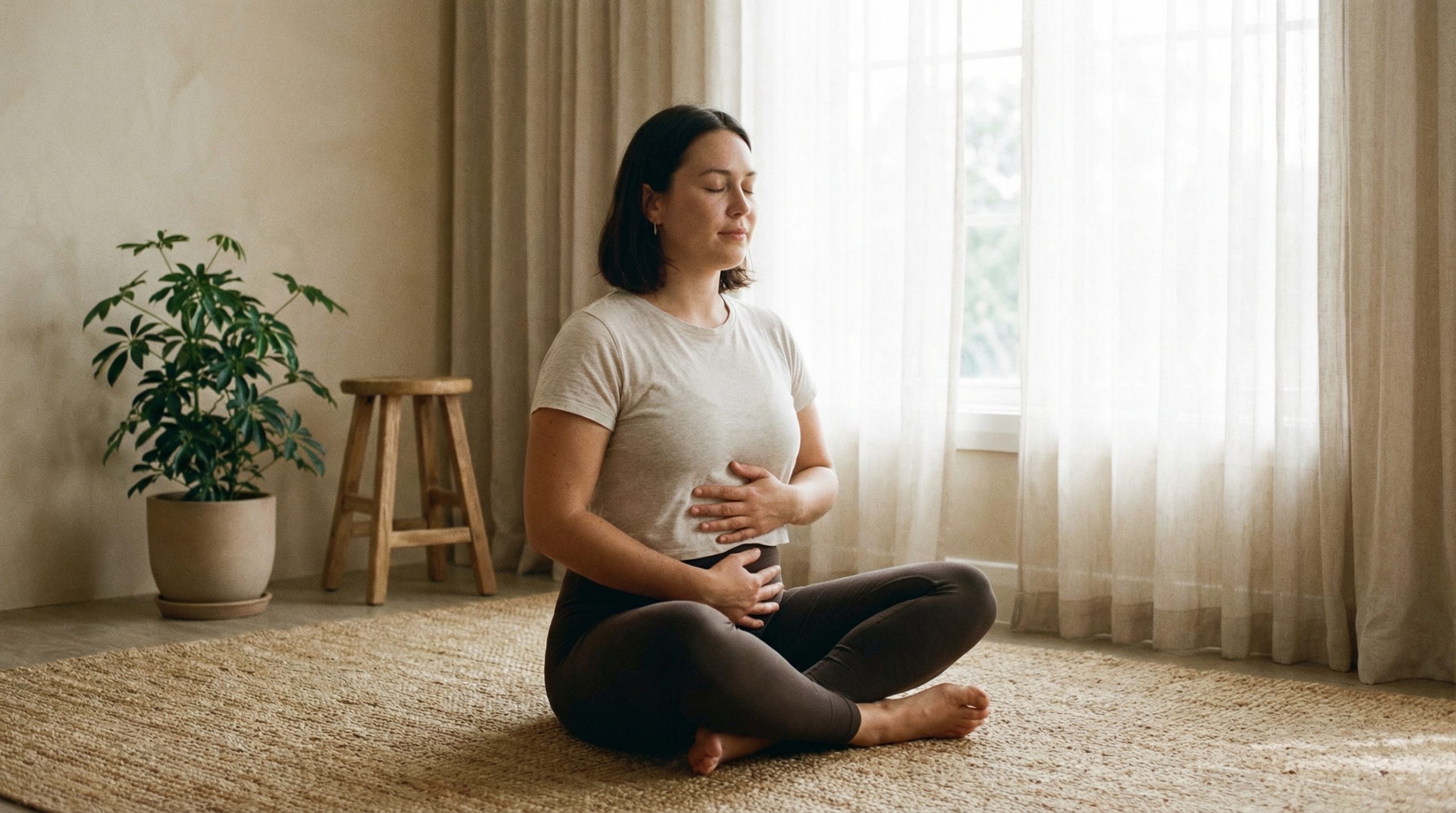
- Put one hand on the upper chest, one on the belly.
- Inhale gently through the nose.
- Let the lower hand move first (easy expansion, not a push).
- Soften into the side ribs, then exhale and let the whole body drop.
If your shoulders keep lifting, reduce the inhale size by about 20%. Smaller is often safer—and more effective.
3) Overbreathing too early
This is the big one.
Many beginners think strong sensations mean strong progress.
Often it’s simply too much breathing, and not enough awareness and relaxation.
It often feels like:
- Lightheadedness or dizziness
- Tingling in hands, lips, or face
- Pressure in the head, agitation, or panic
Quick fix (downshift fast):
- Slow the pace immediately.
- Don’t use effort on the inhale.
- Lengthen the exhale (for example: 4 seconds in, 6 seconds out).
- Do 5 soft rounds, then reassess.
Rule of thumb: when it spikes, soften first. Don’t push through.
4) Forcing the exhale
Some people turn the exhale into a workout. They squeeze the throat. They force of blow trying to “empty completely.” The body reads that as effort, not relief.
It often feels like:
- Throat strain
- Harsh or noisy exhale
- More tension after each breath
Quick fix:
- Keep the throat soft and open.
- Let the exhale “melt” out, rather than push out.
- Try a silent nasal exhale for 6–8 seconds.
- If you like structure: 4–4–4–4 box breathing for 5 gentle rounds.
If you have to strain to hit the count, the count is too ambitious today. Comfort first. Precision later.
5) Following the script instead of listening
Guided sessions can be helpful—until you start obeying them more than your body.
Then you ignore useful feedback.
And practice becomes something you “get through,” not something you learn from.
Use this 3-signal check:
- Breath: smooth or strained?
- Body: softening or tightening (jaw, belly, throat, shoulders)?
- Mind: more present or more frantic?
If it points toward strain, downshift right away. Softer inhale. Longer exhale. Slower pace. Eyes open if needed.
The goal is not to force an experience.
The goal is to build a relationship with the breath.
In breathwork, steady usually goes further than intense.
Breathwork course reset: a beginner-friendly 5-minute practice
If you want one practice that’s simple, portable, and hard to overdo, use this.
It’s not designed to create fireworks.
It’s designed to bring you back.
- Sit comfortably. Relax the jaw, shoulders, and belly.
- Breathe through the nose if possible.
- Inhale gently for 4 seconds.
- Exhale smoothly for 6 seconds.
- Repeat for 10 rounds.
- Then breathe naturally for 60 seconds and notice what changed.
Shortcut reminder: when in doubt, softer the inhale. Calm comes from relaxed pacing—not from “more.”
How to choose the right breathwork course
Free videos can be useful for exploration.
But a good course gives you something free content rarely provides:
progression.
A beginner-friendly breathwork course should teach:
- Breathing mechanics (without rigidity)
- Pacing and downshifting
- What common sensations mean (so you don’t misread them)
- How to practice consistently without burning out
- When to go for it, when to pause, and when to get support
Red flags:
- Everything is framed as “go bigger” or “push harder.”
- There’s no mention of downshifts, recovery, or self-regulation.
- Strong sensations are treated as the only proof of progress.
- You feel pressured, dependent, or confused.
If you want a clear next step, explore Training Programs, learn about the Practitioner Program, or browse the Breath Mastery blog.
Breathwork course FAQ
Is breathwork safe for everyone?
Many gentle practices are safe for most people. Still, intensity matters. If you feel dizzy, panicky, numb, or overwhelmed, simplify: smaller inhale, slower pace, longer exhale. If you have health concerns, choose a gentle approach and consider professional guidance.
Why do I feel anxious during breathwork?
Often it’s overbreathing or effort. The fix is usually the same: soften the inhale, slow the rhythm, and lengthen the exhale.
Do I need a breathwork course, or can I learn from YouTube?
You can learn basics from free content. A course becomes valuable when you want structure, safety, progression, and a plan for what to do when sensations get strong.
How long should I practice each day?
Consistency matters more than duration. Five minutes a day done gently and steadily can beat occasional intense sessions.
What’s the fastest way to calm down?
Try a longer exhale for 1–3 minutes. For example: 4 seconds in, 6 seconds out. Keep it quiet. Keep it easy.
Conclusion
Breathwork works best when it becomes simple.
Not because it’s shallow.
But because it’s honest.
When you stop forcing and start listening, the practice gets clearer. You build steadier calm. You trust your body again. That’s the point of a real breathwork course: not more sensation—more skill.
Next step: Explore Breath Mastery Training Programs or see upcoming live events for guided support.
References
- NHS: Breathing exercises for stress
- Cleveland Clinic: Respiratory alkalosis (hyperventilation and symptoms)
- Cleveland Clinic: Diaphragmatic breathing
- NCCIH: Mind and body approaches for stress
Disclaimer: Educational content only. Not medical advice. If you have a medical condition, are pregnant, or have a panic/trauma history, start gently and consider professional guidance before intense breathwork.
