
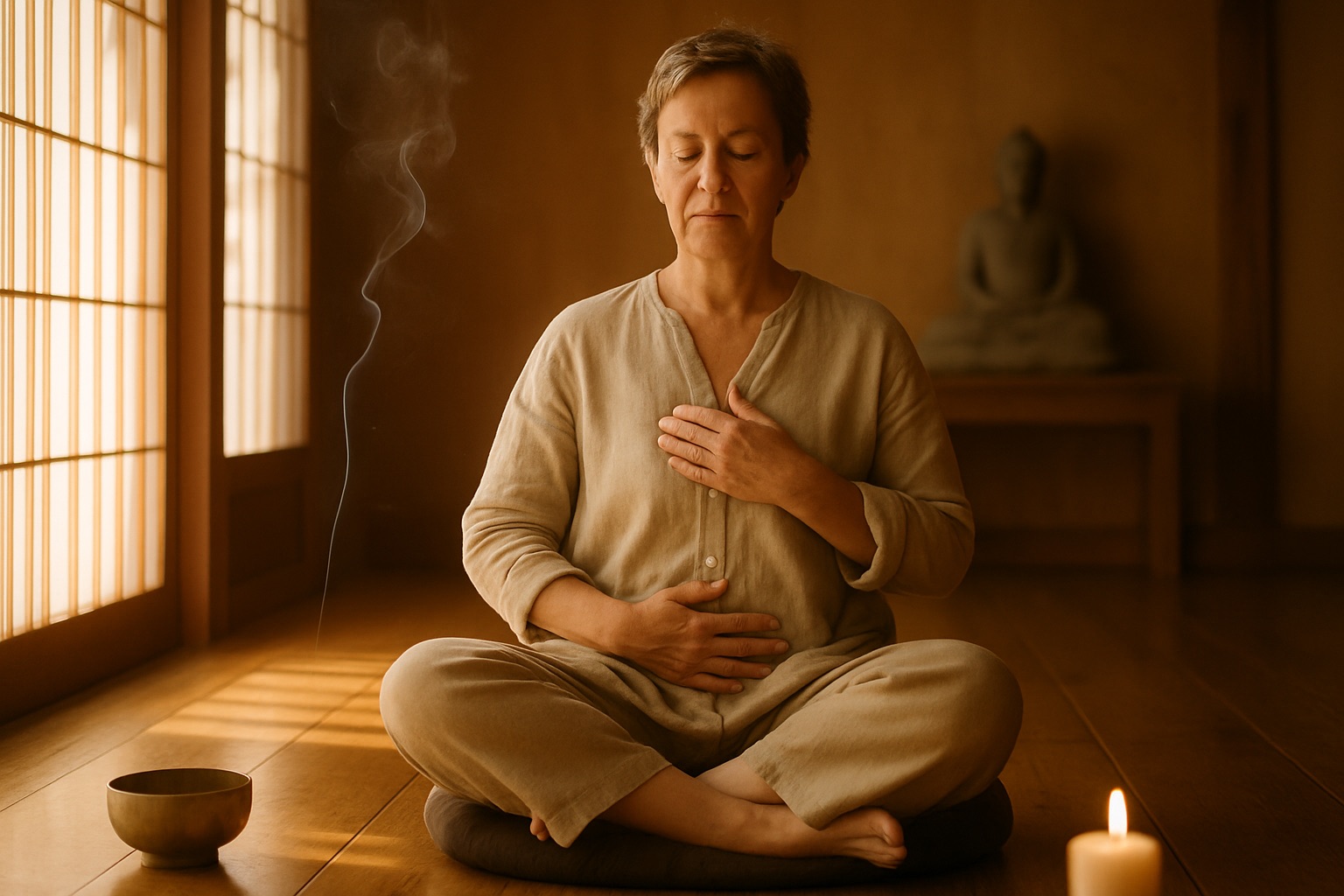
Buddhism offers a rich understanding of how to meet whatever comes up in a breathwork session—and how to carry that understanding into daily life. Those of you who have trained with me know that we need to practice non-judgment, non-resistance, and non-attachment in a Breathwork session.
Breath Awareness—the first and most basic aspect of Breathwork—is called Mindfulness of Breathing in the Buddhist tradition. And it involves calmness, joy, and letting go. In Breathwork as well as Buddhist breathing practice, we learn to sense details in the breath and we become more conscious of the reactions of our body-mind system.
Acknowledging impermanence (Anicca) is explicitly included in the Buddha’s instructions on breathing. We observe that the breath comes and goes, as do all thoughts, sensations, and emotions. And during a session, we practice observing those changes without demanding that they go away or remain. In life, this encourages both patience with difficulty and an appreciation for what is.
The Buddha used the example of a stringed instrument: strings that are too tight or too loose cannot play properly. Breathwork practice likewise requires an appropriate balance of effort and relaxation. In breathwork, we learn to sense how much of each is useful. Sometimes the skillful move is greater engagement; sometimes it is softening, slowing, or stopping.
The Buddha taught loving-kindness and compassion—He taught us to meet our experience with a friendly heart and to respond to suffering with discernment and care. In breathwork. He taught us to approach pain, tension, fear or sadness as we would someone we love who is struggling.
Another powerful Buddhist teaching is equanimity. That means steadiness while remaining open. In breathwork, we give a quiet session the same respectful attention as an emotionally powerful one.
And we learn to keep breathing and to keep relaxing regardless of our changing circumstances. In life, this means remaining conscious and steady through praise, criticism, success, and disappointment. We can learn to care deeply and yet not be demanding.
The Buddhist principle of Mudita is the cultivation of joy in the well-being and good fortune of others. In group breathwork, we learn to appreciate another person’s opening without measuring our experience against theirs. In life, this means celebrating someone else’s success, so that their happiness becomes something we participate in.
In Breathwork we learn to stop identifying with our body-mind system and to simply witness it instead. In Buddhist teachings this is called anatta—challenging the identification with our physical and mental processes.
For example, when fear is present, we learn to say “my system is in a panic” rather than “I am afraid.” In life, we learn to hold labels such as “failure,” “expert,” or “the strong one” more lightly.
The Buddha distinguished between the pain of an initial experience and the additional suffering that our reaction can bring. He called it being struck by two arrows.
During breathwork, we notice the thing and our reaction to the thing: “I shouldn’t feel this. I’m doing this wrong.” In life, we recognize when disappointment becomes self-condemnation. We need to be gentle. Even the mind’s judgments deserve compassion.
Thich Nhat Hanh’s teaching of interbeing emphasizes that things exist through their relationships with other things. Breathing offers a tangible experience of how your life depends on an ongoing exchange of energy with the world around you.
Buddhist teachings include how we speak, act, and relate to others. And Mindful Breathing is explicitly connected with deep listening, truthful speech, and responding wisely to anger.
In breathwork, we practice bringing gratitude, honesty, respect, and care as a teacher and a student. In life, we want this practice to influence our next conversation, promise, or difficult decision.
A good question to ask yourself often along the path of Breath Mastery is: Am I becoming more conscious and compassionate, more patient, more truthful, and more open and available to the people I love?
I hope you will take some of this to heart and that on your own you will explore how Buddhist principles—or Christian principles for that matter—can deepen and elevate your Breathwork Practice.
Sending you much love and wishing you many blessings on your path!

October, 2026
Breathmastery.com