
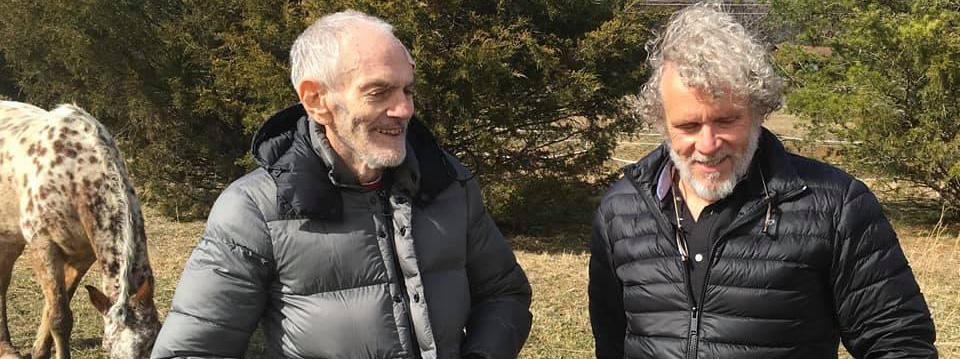
If you are searching for Rebirthing Breathwork, Leonard Orr is where the lineage begins. Leonard, my dear friend and one of my favorite teachers, used to describe the practice as “merging the outer breath, which is air, with the inner breath, which is Spirit.” That single line is the doorway.
Who is Leonard Orr?
Leonard Orr is the founder of Rebirthing Breathwork, a healing approach that uses conscious connected breathing to reach and let go of deeply held emotional, mental and physical patterns. His work began in the 1960s and really took off through the 1970s, essentially establishing much of what we now see as modern breathwork practice. A lot of people also see him as one of the most influential voices in the history of conscious breathing, as a therapeutic instrument.
Born in 1937 in upstate New York, Leonard Orr grew up in a modest, religious household. From an early age, he was drawn to questions about the mind, consciousness, and the relationship between thought and experience. His spiritual curiosity eventually led him to explore a wide range of traditions, including the teachings of Shri Mahavatar Babaji, the legendary immortal yogi of the Himalayas, which significantly influenced his later philosophy around spiritual purification and the nature of the body.
The discovery that would change everything happened kind of by accident. Beginning around 1962, Orr started having spontaneous regression moments while he was just soaking in his bathtub, vivid states where he accessed memories tied to his birth, and even those earlier prenatal phases. Instead of tossing it away as mere imagination, he didn’t. He kept returning, and over time, spent years closely watching and documenting what was showing up. What really stood out was this: when the breath turned continuous, with no pause between inhale and exhale, then it seemed to spark these deep awareness fields, and help the unresolved material come up and get woven together. That idea then became the main cornerstone of what he later named Rebirthing: the conscious connected breath as a kind of healing vehicle.
By the mid-1970s, Orr had developed a method that he was sharing with others, initially in warm-water sessions and later in “dry” sessions as well. His early clients included notable figures like Werner Erhard of EST (now Landmark Education) and breathwork pioneer Stanislav Grof. Students who trained under him went on to found their own schools and lineages, among them were me, Dan Brulé (Breath Mastery), Sondra Ray (Liberation Breathing), and Judith Kravitz (Transformational Breath®).
Leonard Orr’s impact on the breathwork movement is kind of immeasurable, honestly. He didn’t only develop some technique; he opened a doorway for thousands of practitioners, and then millions of people later walked right through it. His insistence that breath, thought, and awareness are inseparable tools for healing still feels relevant today, just as it did when he first articulated it.
What Rebirthing Breathwork actually is
Rebirthing Breathwork, also called Conscious Connected Breathing, is a simple practice with profound effects. Each breath is connected to the last one and to the next, with no pauses or gaps. The inhale turns into the exhale. The exhale merges with the inhale. It is like a wheel turning. You pull the breath in actively. You let the breath out passively. No pushing, no blowing, no forcing of the exhale. You snap it loose and let it go.
Leonard discovered the practice through spontaneous experience between 1962 and 1975. He noticed that when the breath moved continuously in this way, deep memories and energies in the body began to release. He went on to found Theta House in San Francisco, a Victorian mansion where students gathered for One Year Seminars. He named it Theta because theta brain waves are the scientific marker of the transcendental state, what the yogis call samadhi.
How to start: the 20 Connected Breaths
Here is the entry exercise Leonard developed. It is a taste of the work, not the full practice, but it is enough to feel what the breath wants to do.
Count 20 connected breaths. Every fifth breath is a big one. Four small breaths, then a big breath. Four small, then one big. Four small, then one big. Twenty breaths in all.
The inhale is active. The exhale is passive. Pull the breath in. Let the breath out. You can breathe in and out through your mouth, or in and out through your nose. Just do not breathe in the nose and out the mouth.
Before you begin, go inside with meditative awareness and see how you feel. Then do the exercise. Then check inside again. Notice what gets activated in you.
Do the 20 Connected Breaths three times in a session, with a few minutes of meditation between each round. Once at medium speed. Once slow. Once fast. Keep the four-to-one ratio.
What happens when you breathe this way
When you breathe in this connected way, energy begins to move. Thoughts, feelings, sensations, and emotions stored in the body start to surface. This is normal. If anything uncomfortable comes up, it means it is leaving you. Keep the breath moving. Relax whatever you can. Be patient with everything else.
The breath is doing two things at once. On the inhale, the diaphragm draws blood from the extremities into the lungs. On the exhale, it sends blood back out. This is the thoracic pump, the way breathing helps the heart do its work. After a few minutes of continuous breathing, heart rate variability rises, cortisol drops, and the nervous system softens. Ten or twelve minutes in, theta brain waves begin to dominate. That is the state the yogis spend years training to reach in stillness, what Leonard called the transcendental state. The breath gets you there in minutes.
The Core Principles of Leonard Orr’s Rebirthing Breathwork
Leonard Orr’s approach to Rebirthing was never just a breathing technique; it was a complete philosophy of healing that integrated breath, body, mind, and spirit. Understanding the core principles he developed helps clarify why this practice has endured and why so many people find it transformative. There are four foundational elements at the heart of his method.
Connected Breathing
Rebirthing’s most distinctive point is the conscious connected breath, a sort of unbroken rhythmic breathing pattern where the inhale just sort of flows straight into the exhale with no pause in between. And this continuous circular breathing is not forced, or what some people call hyperventilatory. It’s usually gentle, and yes quite intentional. If you keep that uninterrupted rhythm going, the usual thinking mind starts to quiet down a bit, then attention drops into deeper layers of the body-mind, where stored memories and recurring patterns tend to sit. Orr felt this breathing style was more like a natural healing intelligence, something the body already has and understands. So the practitioner’s role becomes less about pushing, more about letting it happen, and not getting in the way.
Relaxation
Orr placed enormous importance on relaxation as a precondition for healing. He famously stated, “Relaxation is the ultimate healer. Every breath induces relaxation. Therefore, breathing is the basic healer.” In Rebirthing sessions, the practitioner guides the client to soften and release physical tension as it arises rather than brace against it. This is a subtle but profound distinction. Instead of trying to control or manage what comes up, the client is encouraged to relax into it. Orr understood that healing rarely happens through force; it happens through allowing.
Energy Awareness
As the connected breath deepens, a lot of people start to notice little sensations of energy moving through them, you know, like tingling warmth, pressure, or even waves of aliveness. Instead of getting alarmed, Orr taught that these experiences are basically signs of so-called “energy cycles” finishing themselves. Not fully completed experiences or emotions that were held in the body are now being processed and then released with the help of breathing. Building awareness around these energetic shifts, and learning to stay right here with them, rather than pushing them away, seems like a core step in the Rebirthing process.
Emotional Release
Maybe the deepest part of Orr’s work is how it can enable real emotional release. Since the connected breath sidesteps the analytical mind, it can reach emotional material that ordinary talk therapy may not uncover, especially patterns that come from early childhood, birth trauma, and sometimes even prenatal experience. In this steady and supported condition, those stored feelings can rise up, be fully felt, and then dissolve. Clients often mention a deep kind of relief, more clarity, or that lightweight sensation after a session. Orr did not frame it as something that is “done to” the client. More like, the body’s own intelligence is completing what it was always trying to complete, in its own quiet way.
Why a teacher matters
Most beginners get distracted by the sensations and forget to keep the breath flowing. That is why Rebirthing Breathwork was designed to be learned the traditional way: through initiation, one teacher passing the work to one student. A trained Rebirther can hold the space, read what is happening, and guide you back to the breath when you wander.
I learned Rebirthing Breathwork from Leonard in 1976. His work now spans 67+ countries through the teachers he and his students trained over five decades. If you are serious about this practice, find a trained Rebirther near you. The traditional arc is ten one-on-one sessions, one to two hours each.
Stay close to the practice
A few minutes of connected breathing a day will keep the channel open between sessions. The breath is always available. The practice is simple. The transformation, when it comes, is not.
Subscribe to the Breath Mastery newsletter for travel schedules, upcoming workshops, and Dan’s monthly teaching email on Rebirthing Breathwork and the lineage Leonard Orr started.
Good luck in your practice, and many blessings on your path.
Frequently asked questions
Who founded Rebirthing Breathwork?
Leonard Orr is the founder of Rebirthing Breathwork. He developed the technique through his own spontaneous experiences between 1962 and 1975 and went on to teach it through Theta House in San Francisco and the international Rebirthing-Breathwork movement.
How is Rebirthing Breathwork different from Holotropic Breathwork?
Both use continuous connected breathing. Rebirthing Breathwork, as Leonard taught it, is typically learned one-on-one in a series of ten sessions. Holotropic Breathwork, developed by Stanislav Grof, is usually practiced in groups with music and a partner sitter.
Is Rebirthing Breathwork safe?
Connected Breathing can activate strong sensations and emotions, and beginners sometimes trigger hyperventilation symptoms. That is one reason to start with a trained Rebirther. If you have a serious heart, lung, or psychiatric condition, talk to your doctor before beginning.
How long is a Rebirthing Breathwork session?
A one-on-one session is typically one to two hours. The traditional arc is ten sessions with the same Rebirther.
By Dan Brule, founder of Breath Mastery. Trained as a Rebirther by Leonard Orr in 1976. Has taught Conscious Breathing to 350,000+ students in 77 countries and certified 2,000+ Breathwork Teachers, Coaches, Practitioners, and Facilitators.