Monthly Archives

April 2026

breathing techniques for anxiety1

Breathing Techniques for Anxiety at Night: Stop the Spiral

By Blog No Comments

Key Takeaways

  • Nighttime anxiety activates the sympathetic nervous system — which is incompatible with sleep. Per the National Center for Complementary and Integrative Health, breath-based relaxation is among the most evidence-supported non-pharmacological interventions for anxiety-related sleep difficulty.
  • The extended exhale (longer out than in) is the fastest entry point. Start here, every time, before attempting more structured techniques.
  • 4-7-8 breathing uses breath-holding to slow the nervous system and gives a racing mind something concrete to count: it interrupts the spiral through engagement, not suppression.
  • Coherent breathing at approximately 5 breaths per minute produces measurable HRV increases after just 10 minutes of practice, per Zaccaro et al. (2018) in Frontiers in Human Neuroscience. Best for chest tightness and pounding heart.
  • You don't need to clear your mind. The physiological shift happens regardless of whether thoughts are still present. Return to the next exhale — always the exhale.

It's midnight. Your body is tired. Your mind is not. Breathing techniques for anxiety at night work differently than anything you'd reach for during the day — and that difference is exactly why they work.

The thoughts come in loops. Something you said three days ago. Something you haven't done yet. Something that might happen, probably won't, but feels inevitable at 1 a.m.

What actually happens in your body when anxiety takes hold at 2 a.m. and refuses to release? Your chest tightens. Your breath shortens. You check the time, calculating how many hours of sleep you'd still get if you fell asleep right now, and the calculation itself makes things worse.

This is the nighttime anxiety spiral. The breathing techniques for anxiety at night described in this guide interrupt it — not by suppressing your thoughts, but by changing the physiological state feeding them. Breath-based relaxation is among the most evidence-supported non-pharmacological interventions for anxiety-related sleep difficulty.

In 50 years of teaching these practices to more than 300,000 people across 73 countries, Dan Brulé has found one consistent pattern: the people who sleep better aren't usually the ones who learn to think differently at night. They're the ones who learn to breathe differently.


Why Nighttime Anxiety Hits Differently Than Daytime Stress

Stress during the day has outlets. You move, you act, you talk, you solve. At night, none of those are available — which is exactly why breathing techniques for anxiety at night matter as a standalone approach. As a result, the nervous system stays activated with nowhere to discharge the energy. Research consistently links anxiety disorders with sleep disturbance, and the Cleveland Clinic identifies anxiety as one of the most common causes of sleep disorders, precisely because the systems that produce worry and the systems that produce sleep are mutually antagonistic.

Anxiety activates the sympathetic nervous system: the branch that evolved to respond to danger. Heart rate rises. Cortisol releases. The body genuinely believes something requires urgent attention. This is the wrong state for sleep. Sleep requires the parasympathetic branch: rest, restoration, the long slow exhale.

Breathing is the most direct switch between these two states, and breathing techniques for anxiety at night leverage that directly. When your options are limited, the breath is often the only switch available.


Before You Start: The One Thing Anxious Breathers Get Wrong

The instinct when anxious is to take a big breath in, seeking "control" over the situation. This almost always makes things worse. A forced inhale signals urgency to the nervous system. The body reads the effort as confirmation that something is happening, and ramps its response up rather than down.

All effective breathing techniques for anxiety at night share a common starting point: soften the inhale before doing anything else. Make it quieter, smaller, gentler. Then work from there. The NHS recommends this same principle: relaxed pacing produces calm; effort does not.

There's a second misconception worth addressing before you begin. Most people expect breathing exercises to immediately quiet the mind. When the thoughts don't stop, they assume the technique has failed and give up. However, the physiological shift that breathing techniques for anxiety at night produce (slower heart rate, lowered cortisol, activated vagus nerve) happens in the body regardless of whether the mind has quieted. In practice, students consistently report that the thoughts lose urgency over time, not in an instant. The technique is working even when you can't feel it yet.

For example, a gentle six-second exhale does more for your nervous system than a forceful deep inhale. Don't use effort on the inhale. Calm arrives through relaxed pacing.


The 4 Breathing Techniques for Anxiety at Night

These four breathing techniques for anxiety at night are listed in order of complexity. Start with the first. Move to the others only if needed. The chart below maps all four against speed of effect and technique complexity, so you can choose based on how activated you are when you reach for help.

Nighttime Breathing Technique Matrix: Speed vs. Complexity A 2x2 matrix showing four breathing techniques for nighttime anxiety. X-axis: speed of effect from fast (left) to slower (right). Y-axis: complexity from simple (bottom) to structured (top). Bottom-left quadrant holds Soft Exhale as the recommended starting point. Top-left holds 4-7-8 Breathing. Bottom-right holds Coherent Breathing. Top-right holds Body Scan Breathing. Source: Breath Mastery Practice Guidelines. Choose Your Technique: Speed vs. Complexity Start bottom-left. Move right for more time, up for more structure. Soft Exhale No counting. Start here. Immediate effect. START HERE 4-7-8 Breathing Counting stops the spiral. Quick nervous system drop. Not for all conditions Coherent Breathing Gentle, even rhythm. HRV reset over 10 min. Best for physical anxiety Body Scan Breathing Exhale through each body zone. Releases held tension. Best for physical tension Faster Effect Slower Effect Simple Structured COMPLEXITY SPEED OF EFFECT Source: Breath Mastery Practice Guidelines | Dan Brulé
Start at the bottom-left (Soft Exhale). Move right for more time, or up for more structure, only if the simpler technique isn't sufficient.
Technique Duration Difficulty Best For Physiological Action
Soft Exhale 2–3 min Simple Any anxiety level; first response Vagus nerve activation via 2:1 exhale ratio
4-7-8 Breathing 2–4 min Moderate Racing thoughts, looping mind Breath hold deepens parasympathetic response
Coherent Breathing 10 min Simple Chest tightness, pounding heart HRV optimization; synchronizes cardiorespiratory rhythms
Body Scan Breathing 10–15 min Moderate Physical tension alongside mental anxiety Progressive somatic release tied to each exhale

Technique 1: The Soft Exhale (Start Here)

Among all breathing techniques for anxiety at night, the Soft Exhale is the most direct entry into a calmer nervous system. It requires nothing except a willingness to let your exhale run longer than your inhale. Research consistently shows that extending the exhale beyond the inhale at a ratio of roughly 2:1 activates the vagus nerve and shifts the autonomic nervous system toward parasympathetic dominance. No timer required. No silence required.

  1. Lie on your back. Place one hand on your belly, one on your chest.
  2. Inhale slowly through your nose. Let the breath come in naturally without forcing it.
  3. Exhale slowly through your mouth, as if fogging a mirror. Let the exhale be soft and long, lasting about twice as long as the inhale.
  4. Repeat six to eight cycles.

The only goal is that extended exhale. If it points toward strain at any point, downshift: softer inhale, longer exhale, slower pace. This technique either works within six cycles or it doesn't work alone. If nothing shifts, move to Technique 2.

Technique 2: 4-7-8 Breathing

When the mind is looping and the Soft Exhale isn't sufficient, 4-7-8 offers another effective breathing technique for anxiety at night — it gives the analytical brain something concrete to count. The counting structure is deliberate: it occupies the part of the mind that generates the spiral while the breath simultaneously shifts the physiology underneath it. This technique derives from Pranayama traditions and was adapted for sleep by integrative physician Dr. Andrew Weil.

  1. Inhale through the nose for a count of 4.
  2. Hold the breath for a count of 7.
  3. Exhale through the mouth for a count of 8.
  4. Repeat for four cycles total.

The ratio matters more than the specific numbers. If holding for 7 counts feels uncomfortable, use 4-6-7 or 3-5-6. The extended hold is what deepens the parasympathetic response: it sends the body a clear signal that no immediate threat is present.

Note: Breath holding is not appropriate for everyone. If you have high blood pressure, cardiovascular conditions, or a history of panic attacks where breath holding worsens symptoms, skip this technique and use the Soft Exhale or Coherent Breathing instead.

Technique 3: Coherent Breathing for Sleep

Coherent breathing at approximately five cycles per minute synchronizes the cardiovascular and respiratory systems, producing measurable increases in heart rate variability (HRV). Research by Zaccaro et al. (2018) in Frontiers in Human Neuroscience found that slow-paced breathing at around five cycles per minute significantly increases HRV and reduces self-reported anxiety, with effects measurable after ten minutes of practice. Among breathing techniques for anxiety at night, Coherent Breathing is therefore the most effective when anxiety has a physical quality: chest tightness, shallow breath, heart pounding.

  1. Inhale for five to six seconds through the nose.
  2. Exhale for five to six seconds through the nose.
  3. No pauses, no effort: a smooth, continuous rhythm.
  4. Continue for ten minutes.

In practice, students who apply this technique consistently before sleep report that within one to two weeks the response becomes automatic. The nervous system learns the rhythm and begins to associate that breath cadence with sleep onset. For a shorter daytime version of this same technique, see Breathing Exercises for Stress: A 5-Minute Reset.

Technique 4: Body Scan Breathing

When anxiety is rooted in physical tension, adding a body scan deepens the release that Coherent Breathing begins. Nighttime anxiety almost always has a somatic component: the jaw, the chest, the hips hold arousal that the mind keeps generating. The Body Scan gives each exhale a specific target rather than asking the body to release tension in general.

Start at the top of the head and work down. As you exhale each breath, consciously soften one area:

  • Exhale: relax the jaw. Let the tongue rest softly on the roof of the mouth.
  • Exhale: soften the shoulders. Let them drop away from the ears.
  • Exhale: release the chest. Let it spread wide rather than holding inward.
  • Exhale: soften the belly. No effort, no bracing.
  • Exhale: release the hips and legs. Let the floor take their weight.

By the time you reach the feet, breathing has typically slowed on its own and the body has released at least some of the tension it was carrying. This technique works well after Coherent Breathing, not instead of it.


Breathing Techniques for Anxiety at Night: What to Do When Thoughts Intrude

The mind at night is persistent. You start one of these breathing techniques for anxiety at night and a thought arrives. You follow the thought. Three minutes later, you realize you've stopped breathing deliberately. This is not failure. This is what minds do.

The response is simple: when you notice you've drifted, return to the next exhale. Not the next inhale — the next exhale. The exhale is where the physiological shift happens, and therefore that's where your attention belongs.

You don't need to clear your mind to benefit from these techniques. The physiological changes happen in the body regardless of whether thoughts are still present. However, what does change over time with consistent practice is that the thoughts lose urgency. They're still there, but they feel less like emergencies. This is the nervous system learning that exhaling means safety.


The Role of Nasal Breathing at Night

One specific detail that makes a measurable difference at night: breathing through the nose rather than the mouth. Nasal breathing produces nitric oxide, which improves oxygen uptake and acts as a mild vasodilator. It also maintains CO2 levels in the bloodstream, which are important for blood vessel dilation and oxygen delivery to the brain. Mouth breathing during anxiety tends to be faster and less regulated, which actively undermines the calming effect of breathing techniques for anxiety at night — feeding the same over-arousal pattern you're trying to interrupt.

When in doubt, nose in, nose out. The full science behind why nasal breathing matters and why CO2 plays a central role is covered in The Science of Breathing: CO2, Calm, and Why Slow Breathing Works So Fast.

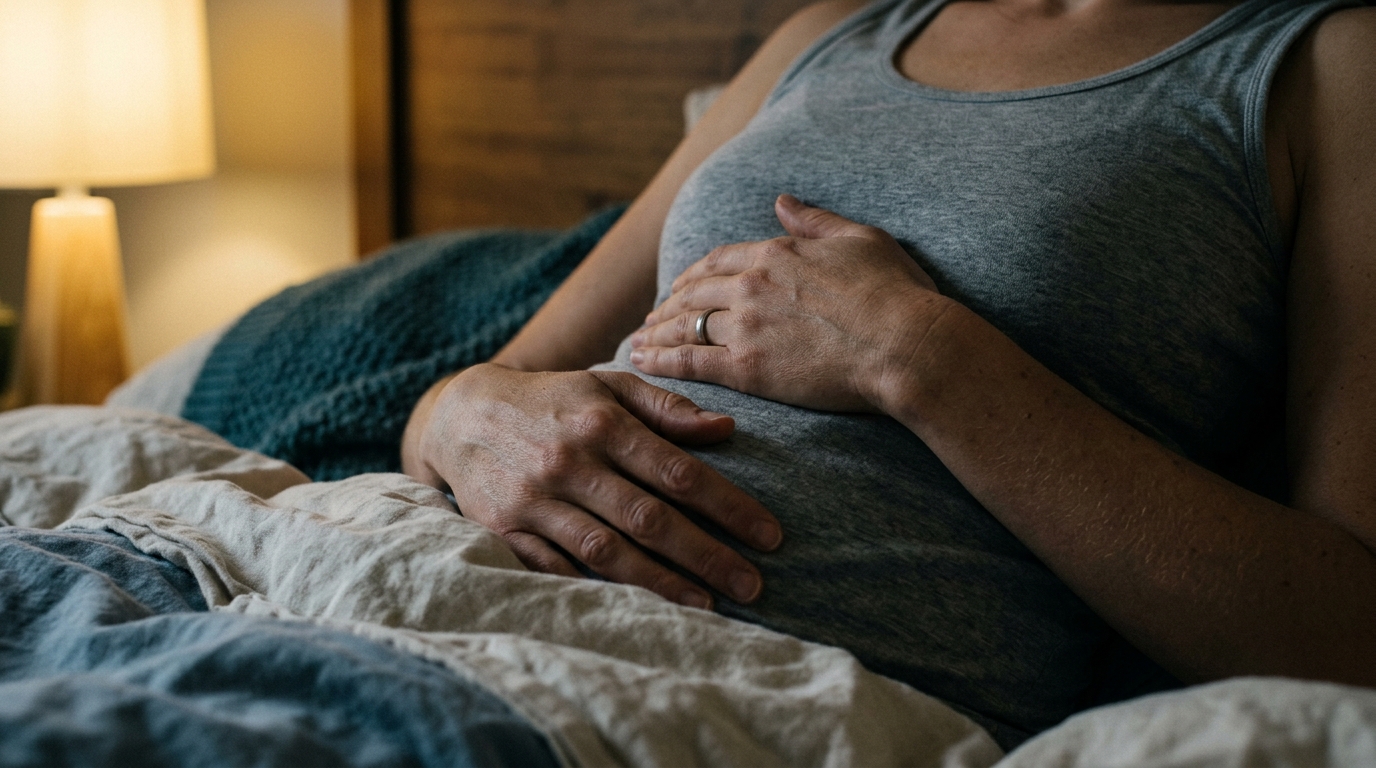
Woman lying in bed at night with her hand on her chest, using breathing techniques for anxiety at night to calm a racing mind
The moment anxious thoughts start to slow down — one hand on the chest, attention on the exhale.

The Role of Nasal Breathing at Night

One specific detail that makes a measurable difference at night: breathing through the nose rather than the mouth. Nasal breathing produces nitric oxide, which improves oxygen uptake and acts as a mild vasodilator. It also maintains CO2 levels in the bloodstream, which are important for blood vessel dilation and oxygen delivery to the brain. Mouth breathing during anxiety tends to be faster and less regulated, which actively undermines the calming effect of breathing techniques for anxiety at night — feeding the same over-arousal pattern you're trying to interrupt.

When in doubt, nose in, nose out. The full science behind why nasal breathing matters and why CO2 plays a central role is covered in The Science of Breathing: CO2, Calm, and Why Slow Breathing Works So Fast.

Close-up of hands resting on the ribcage and belly, feeling diaphragmatic breathing rise and fall — a core mechanic behind breathing techniques for anxiety at night
Nasal breathing at night maintains CO2 balance and regulates breath rate, two factors that directly affect how quickly anxiety subsides.

Frequently Asked Questions

Why does anxiety get worse at night specifically?

During the day, the prefrontal cortex (the thinking, evaluating part of the brain) remains active and largely keeps the amygdala's threat-detection in check. At night, sleep pressure and lower stimulation reduce prefrontal activity, giving the amygdala more room. Thoughts that felt manageable during the day can feel urgent or catastrophic at 1 a.m. Breathing works here because it acts directly on the physiological state without requiring the prefrontal cortex at all. This is why techniques that would seem "too simple" during the day can be genuinely effective at night.

Can breathing techniques for anxiety at night feel strange or increase anxiety at first?

Yes, for some people. If you're not accustomed to paying attention to your breath, the increased awareness can initially feel odd or even anxiety-provoking. This is common and temporary. If a particular technique increases discomfort, stop and return to normal breathing. Start with just a few cycles rather than a full ten minutes, and build gradually over several nights until the practice feels familiar and safe. The Soft Exhale is generally the gentlest starting point for people who are sensitive to breath-focused attention.

Can I use breathing techniques for anxiety at night if I wake up at 3 a.m.?

Yes. The Soft Exhale and Coherent Breathing are both well-suited to middle-of-the-night awakening. Start with just three to four slow exhales before attempting anything more structured. If you're fully awake with racing thoughts, sit up briefly for the 4-7-8 technique for four cycles, then return to lying down for Coherent Breathing as you settle. The goal is to work through the sequence progressively, not jump straight to the most structured technique, which can feel effortful when you're already activated.

How Long Before Breathing Techniques for Anxiety at Night Become Reliable?

Some people feel a shift the first time they try. Others need a week of consistent practice before the response becomes reliable. The nervous system learns: the more consistently you use breathing to regulate at night, the faster and more automatic the response becomes. Five to ten minutes before sleep, practiced daily, typically produces measurable improvement in sleep quality within one to two weeks. Peer-reviewed studies document that breathing techniques for anxiety at night produce significant physiological changes after even a single ten-minute slow-breathing session.

Which breathing technique works best when you wake up at 3 a.m.?

Start with the Soft Exhale: three to four slow breaths, exhaling twice as long as you inhale. If you're fully awake with racing thoughts, sit up briefly and try 4-7-8 for four cycles. Then return to lying down with Coherent Breathing at five breaths per minute until you feel settled enough to sleep. The key is progression through the sequence rather than jumping to the most complex technique first. In practice, most people find the Soft Exhale alone is sufficient once the practice becomes consistent.


The breathing techniques in this post are gentle and generally safe. The 4-7-8 technique involves breath holding and is not suitable for people with cardiovascular conditions, high blood pressure, a history of panic attacks where breath holding worsens symptoms, or during pregnancy. If you have a health condition, consult a qualified healthcare provider before beginning any new breathing practice. Breathwork is not a substitute for professional medical or mental health care.


If you want to make these breathing techniques for anxiety at night automatic rather than emergency-only, Mastering the Breath ($97) gives you a structured daily practice built on the same principles — short sessions that train the nervous system response you need before the spiral starts. Over 10,000 people have used it to build exactly that kind of reliable practice. If you're earlier in the process and want to explore first, Breath & Beyond ($97) is a focused entry point into Dan's core framework.


Further reading:

Breathwork Certification: What Makes a Program Legit

By Blog No Comments

Key Takeaways

  • The Global Professional Breathwork Alliance (GPBA) sets 400 hours as the standard for a full practitioner credential — not a weekend intensive.
  • Legitimate programs must include supervised live facilitation, not just video modules or reading.
  • Trauma-informed facilitation is non-negotiable. Breathwork regularly surfaces suppressed emotion and trauma responses.
  • A program that doesn't cover contraindications and scope of practice is not preparing you for real clinical work.
  • Certification is not the endpoint — the best programs offer ongoing mentorship and peer community after graduation.
  • The global wellness economy hit $6.8 trillion in 2024, per the Global Wellness Institute, flooding the field with new credentials and courses, making rigorous evaluation more important than ever.

You've been practicing for a while. The sessions affect you. People close to you have noticed. Some have asked what you're doing, what's shifted, if you could teach them — and whether breathwork certification is the next step.

And something in you knows: this is what you want to do with your time.

So you start looking at breathwork certification programs. And then the confusion starts.

Weekend intensives. Six-month mentorships. Self-paced online courses. Two-day modules that call themselves practitioner training. Prices from $400 to $8,000. Programs backed by instructors who have been teaching since the 1970s, and programs backed by people who discovered breathwork three years ago on social media.

The global wellness economy hit $6.8 trillion in 2024, according to the Global Wellness Institute — and it's projected to reach $9.8 trillion by 2029. That growth has flooded the field with new certifications, new programs, and varying levels of rigor. Quality ranges dramatically.

How do you tell the difference between a training that prepares you to hold space for someone in genuine transformation, and one that teaches breathing patterns while avoiding the hard questions?

This is that guide.

Training hours required across wellness certification levels, 2025
Breathwork Certification Hours by Program Level Horizontal bar chart comparing training hours across breathwork certification levels. Foundational Facilitator: 50 hours. GPBA Standard Practitioner: 400 hours. Clinical Breathwork Certification: 800 hours. Source: Global Professional Breathwork Alliance, 2025. Training Hours by Certification Level 0 200 400 600 800 hrs Foundational Facilitator 50 hrs GPBA Standard Practitioner 400 hrs Clinical Breathwork Certification 800 hrs Source: Global Professional Breathwork Alliance (GPBA), 2025

What a Real Breathwork Certification Prepares You For

The Global Professional Breathwork Alliance sets 400 supervised hours as the standard for a full practitioner credential, reflecting what it actually takes to guide another person's breath practice safely. Many training programs fall well short of this. Understanding what those hours must cover is the first step in evaluating any credential.

A breath session is not a fitness class. People cry. They access memories they have not touched in years. They shake, go silent, ask hard questions, or need someone steady when the breath takes them somewhere unexpected. The job of a certified instructor is not to lead someone through breathing patterns: it is to hold safe, skilled, informed space for another person's process. That requires a specific kind of preparation that videos and reading alone cannot provide.

The Supervised Hours That Actually Prepare You

Theory, in other words, is not enough. You need live practice with actual clients, under a supervisor who can see when you're pulling a session in the wrong direction. Hours matter, and not all hours are equal. A curriculum with 200 self-paced video hours is not the same as 200 hours of supervised live practice.

Look for programs that specify:

  • How many hours of supervised live facilitation (as practitioner, not just as participant)
  • How feedback on your practice sessions is delivered
  • Whether supervision is in-person, live video, or asynchronous review

What "Trauma-Informed" Actually Means in Practice

Breathwork regularly surfaces stored emotion, often without warning. "Trauma-informed" is not a marketing phrase. It is a specific set of skills that includes recognizing early signs of overwhelm or dissociation in a client, knowing when to slow down or stop a session, and having clear referral pathways when what arises exceeds the scope of breathwork practice.

Indeed, the National Center for Complementary and Integrative Health (NCCIH) consistently emphasizes trauma-sensitive approaches in somatic and mind-body practice. Peer-reviewed research by Brown and Gerbarg (2009, Journal of Alternative and Complementary Medicine) confirmed yoga-based breathing interventions significantly reduced PTSD symptoms in mass disaster survivors, underscoring how powerfully the breath accesses trauma stored in the body, and why facilitators without trauma training are genuinely unprepared. Any breathwork certification that doesn't include explicit, practical training in this area is not preparing practitioners for real work with real people.

Specifically, trauma-informed facilitation includes:

  • Establishing safety and consent before any session begins
  • Reading body language and involuntary responses in real time
  • Grounding and integration techniques for when sessions are intense
  • Clear understanding of scope of practice, including when to refer to a therapist or medical professional

Physiological Knowledge That Protects Your Clients

In practice, CO2 tolerance, the autonomic nervous system, the window of tolerance, cardiovascular contraindications: not for lecturing clients, but for making safe decisions in real time. A practitioner who doesn't understand why certain breathing patterns can trigger panic, light-headedness, or cardiovascular stress is not equipped to lead those breathing patterns responsibly.

Three Questions to Ask Any Program Before You Enroll

Currently, breathwork certification programs range from 50 hours to over 800 hours, with prices from a few hundred to several thousand dollars. Before investing time or money, three specific questions will tell you most of what you need to know.

1. How many supervised facilitation hours are included — and how is supervision structured?

In short, reading about breathwork is not the same as running sessions. A course built primarily on video modules and reading materials is not preparing you to sit with a client in a meaningful way. Ask specifically: how many hours of live supervised practice are included? And who supervises: the lead instructor, a teaching assistant, or no one?

2. Who are the teachers, and what is their lineage?

Historically, breathwork has a traceable lineage. Leonard Orr developed Rebirthing in the 1970s. Stan Grof created Holotropic Breathwork. The Pranayama traditions run back centuries. The field grew through direct transmission: supervised practice, personal process work, years with lineage holders.

For example, a teacher who has only learned from online courses is passing on what they've read, not what they've lived. Ask directly: who trained them? How many people have they worked with? What does their personal practice history look like? Understanding breathwork's roots helps you ask the right questions about any program's credibility.

3. What happens after graduation?

Importantly, real skill develops long after a formal qualification ends. Does the training offer peer communities? Advanced modules? Mentorship you can access when something happens in a session you've never encountered before? A credential is not an endpoint. It is the beginning of a practice that needs ongoing support.

Related: Breathwork for Beginners: The 5 Most Common Mistakes: understanding what beginners struggle with helps practitioners anticipate the real challenges they need to manage.

Green Lights and Red Flags: A Side-by-Side Reference

Fortunately, evaluating programs is easier with a clear framework. The difference between a rigorous qualification and a credential-in-name-only usually comes down to a handful of specific indicators. The table below reflects GPBA standards and feedback from working practitioners.

✅ Green Light 🚩 Red Flag
100+ supervised practice hours "Full certification" in a weekend
Live supervision with real feedback Video modules only, no live component
Explicit trauma-informed facilitation training No mention of trauma, boundaries, or scope
Clear contraindications coverage Safety covered in a footnote or not at all
Instructors with 5+ years active practice Instructor is primarily a course creator, not a practitioner
Ongoing community or mentorship post-graduation No support after the course ends

One simple test separates programs that take safety seriously from those that treat it as marketing copy: email the training and ask specifically how their curriculum addresses trauma-informed facilitation. Ask for examples of how students learn to recognize dissociation, manage emotional activation, or determine when to end a session early. The response, and how quickly it comes, tells you a great deal. Programs with real substance in this area answer with specifics: module names, hours allocated, supervision structure. Programs that haven't thought it through give vague reassurances. As a result, this single question does more filtering work than reading any sales page.

A Practice to Try Before You Decide

Before investing in any breathwork certification, try this for three minutes. In practice, most aspiring practitioners discover more about their readiness through direct experience than through program comparison. The Global Wellness Institute projects the wellness economy will reach $9.8 trillion by 2029. That proliferation makes direct experience your single most reliable filter before enrolling anywhere. It demonstrates the two foundations every serious program is built on.

To begin, sit comfortably with your eyes closed. Without changing anything, simply observe your breath. Notice where it moves: belly, chest, or throat. Notice if it is fast or slow, smooth or jagged, quiet or audible. Notice what happens when you pay attention to it without interfering.

After three minutes, take a long, slow exhale — longer than the inhale. Repeat three times.

When ready, open your eyes.

What you just did demonstrates the two pillars this entire field is built on: Breath Awareness (observing without controlling) and Conscious Breathing (directing with intention). Every serious practitioner training returns to these two foundations again and again. If something shifted in those three minutes, you understand why people seek this work out. That's what you'd be helping others access.

For a deeper introduction to these principles before committing to a certification, Mastering the Breath ($97) walks you through both pillars with structured daily sessions — used by over 10,000 students as exactly that kind of pre-certification foundation.

A yoga instructor providing hands-on guidance to a student during class — the kind of supervised, mentor-led training that separates legitimate breathwork certification programs from weekend crash courses
Personal breathwork practice is essential preparation before guiding others. Photo: Unsplash

What Dan Brulé's Breathwork Certification Program Covers

I spent more than 50 years building the knowledge that went into the Breath Mastery practitioner curriculum. I trained with Leonard Orr among the original certified Rebirthers, studied Holotropic Breathwork directly under Stan Grof, trained with Swami Rama at the Himalayan Institute, and was invited by Master Hu Bin to study medical Chi Kung at the Beijing Academy of Chinese Medicine in 1985. Over that time, I have guided breathwork for more than 300,000 people across 73 countries, including Tony Robbins. What I learned from all of it shaped every element of this training.

Consequently, the Breath Mastery One Year Practitioner Certification Program was designed with that depth as its foundation. Over twelve months, participants work through:

  • The Two Pillars: Breath Awareness and Conscious Breathing, as a complete teaching system
  • Individual techniques with both physiological and energetic context
  • Trauma-informed facilitation: what to watch for, how to respond, when to refer
  • Live supervised practice with real feedback on real sessions
  • Personal breathwork process work: a practitioner cannot take a client deeper than they themselves have gone
  • Ethics, professional boundaries, and scope of practice
  • Guidance on building a sustainable breathwork practice and career

In practice, practitioners who complete the program report not just technical competence, but a qualitative shift in how they hold space for others: less reactive, more attuned, and better equipped for the unexpected moments that define real sessions. That shift is what formal supervised practice (not modules alone) makes possible.

What to Expect in Year One as a Practitioner

Year one in a serious certification program follows a predictable structure. Understanding what breathwork certification training looks like month-by-month is one of the most practical steps you can take before enrolling anywhere. GPBA-standard programs require 400 mentored hours, and the best programs deliver that depth in a structured progression over twelve months. The four-phase structure below reflects what that preparation actually requires and produces, so you know exactly what you are investing in and what to ask about.

  1. Months 1–3: Foundation and self-practice. The first phase is largely about your own breathwork: deepening personal practice, understanding your own patterns and responses, identifying what your body does under different breathing conditions. You cannot safely guide what you haven't experienced yourself.
  2. Months 4–6: Technique and physiology. Specific techniques are introduced with their physiological mechanisms, including CO2 mechanics, the autonomic nervous system, the window of tolerance. You begin supervised practice with partners in the cohort, receiving structured feedback.
  3. Months 7–9: Client sessions with supervision. Practice sessions with external clients begin under direct supervision. This is where theory meets reality. Unexpected responses (emotional release, dissociation, resistance, transference) appear here. Supervision is most intensive during this phase.
  4. Months 10–12: Ethics, integration, and graduation. Scope of practice, professional ethics, business development, and integration of everything learned. Graduation marks the beginning of independent practice, supported by an ongoing community.

In breathwork, steady practice over time goes further than an intense weekend ever will.


Frequently Asked Questions

Do I need prior breathwork experience before enrolling in a certification program?

Most serious programs strongly recommend personal breathwork experience before training begins. The practical reason: the more of your own process work you've done, the safer and more grounded you'll be as a facilitator. You cannot take a client somewhere you haven't gone yourself. Starting with a beginner course or sessions with an experienced practitioner is a smart first step.

How many hours does a legitimate breathwork certification require?

The Global Professional Breathwork Alliance (GPBA) sets 400 hours as the standard for a full practitioner credential, including supervised practice hours. Foundational facilitator certificates start at 50 hours. Clinical breathwork certifications run 800 hours or more. Anything claiming "full certification" in under 100 hours deserves careful scrutiny.

Is online breathwork certification legitimate?

There is no single global regulatory body that accredits breathwork certifications across traditions. What matters most is program quality: the experience of the instructors, supervised practice hours included, whether the curriculum covers trauma-informed facilitation, and what support exists after completion. A rigorous online program from lineage-trained instructors often provides more genuine preparation than an in-person weekend intensive with no supervision or follow-up.

Can I teach breathwork without certification?

Legally, breathwork is not regulated in most countries. But running breathwork sessions, especially connected or holotropic-style practices, without training carries real risks. Breathwork regularly surfaces suppressed emotion and trauma. Untrained facilitators may not recognize contraindications, manage activation, or know when to refer. Certification is not just a credential; it's preparation for the complexity of the work.

What can you do professionally with a breathwork certification?

Certified practitioners work in private client practice, corporate wellness settings, retreat centers, yoga studios, healthcare-adjacent programs, and online platforms. The range of professional settings available depends on two factors: training depth and any complementary professional background, such as therapy, coaching, somatic work, or nursing. Many practitioners integrate breathwork into an existing professional role rather than building a standalone practice from zero. For those starting fresh, the most successful early-career paths combine breath practice with a complementary skill set — coaching, yoga instruction, or bodywork — rather than relying on a single credential alone. Mentored hours, lineage training, and a clear scope of practice open more doors than a program's name alone.

How long does breathwork certification take?

Worthwhile programs run between six months and two years. Anything shorter than 100 total hours, including mentored client sessions, raises genuine questions about depth. The Global Professional Breathwork Alliance sets 400 hours as the full practitioner standard, which most serious programs deliver over twelve to eighteen months. Faster programs are not inherently better; accelerated timelines often compress or eliminate the supervised client hours where practitioners develop the skills that matter most. Programs with ongoing mentorship and peer community after graduation consistently produce more capable practitioners than those with a fixed endpoint and no continued support structure. When comparing timelines, ask what specifically fills those hours: video modules and reading do not substitute for live supervised practice.


This post was reviewed for accuracy by Dan Brulé and reflects curriculum standards as of March 2026. See our about page for editorial standards.

Breathwork is not a substitute for professional medical or mental health care. Connected breathing practices and extended breath holds are not appropriate for everyone. Anyone with cardiovascular conditions, a history of seizures or epilepsy, pregnancy, recent surgery, or serious mental illness in acute destabilization should speak with a qualified healthcare provider before beginning any breathwork practice. Breathwork practitioners are not licensed therapists or medical professionals unless they hold separate credentials in those fields.


If you're ready to invest in a breathwork certification that prepares you for real work with real people, the Breath Mastery One Year Practitioner Certification Program is where that preparation happens.

If you're earlier in the journey and want to deepen your own practice before training others, Breath & Beyond ($97) is a focused starting point. For the most thorough preparation available before entering formal practitioner training, Dan Brulé's Breathwork Legacy Collection ($397) covers 500+ lessons across every technique, modality, and application you'll encounter as a practitioner.


Further reading:

Close Menu

Pin It on Pinterest